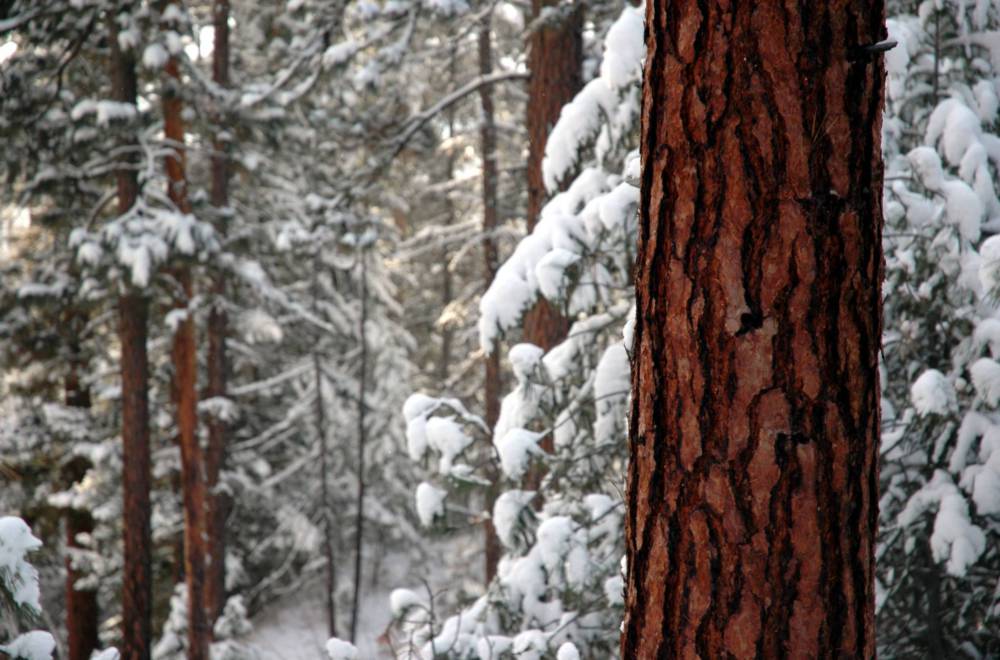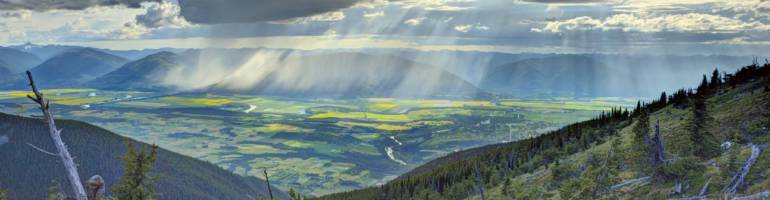
Mountain caribou are an 'ecotype' of woodland caribou that inhabit the deep snowbelt regions of the interior rainforest of British Columbia and parts of three US states. Their large hooves act as snowshoes that allow them to spend winters high in the sub-alpine and alpine forests, where snowpacks can reach depths up to four meters. The deep snows act as a barrier to predators, and as a platform that allows the caribou to reach their winter food source - lichens that grow on old-growth trees. Mountain caribou are the only member of the deer family to move to higher elevations in winter.
Mountain caribou do not undertake extensive migrations like their northern cousins, which may migrate thousands of kilometers each year. Instead, mountain caribou move up and down the mountains throughout the seasons. For most of the year caribou can be found on the mid-to-upper slopes in the wet old growth forests of the interior mountains.
In early winter when the snow is deep but too soft to stand on, the caribou move down to the valley bottoms and eat ground plants such as falsebox. When the snowpack solidifies enough to support their weight the animals move back upslope. They move down again in early spring to feed on succulent plants as the snow melts. In May and June they again move upslope, to give birth to their calves.
Caribou prefer tender, more palatable food sources, as opposed to moose and elk, which can browse on the coarsest of alder and willow bark. During the spring and summer months, caribou prefer herbs such as arnica and groundsel. When the snows arrive in early winter caribou paw down to feed on shrubs such as falsebox. In mid to late winter, when their ground-based foods are buried in snow, mountain caribou live almost entirely on arboreal lichens (lichens that hang from trees), such as Witches Hair and Old Man's Beard. Seasonal movements, habitat use, old-growth dependence and late winter feeding habits make mountain caribou globally unique.
The main threats to mountain caribou are habitat loss, fragmentation, and degradation. Industrial logging has removed much of the critical old-growth forest that caribou need for food and for cover from predators like wolves and cougars. After old forests are logged, young shrubs and trees grow. Moose, deer and elk move in, attracted by the new growth. Their presence in turn supports more predators which incidentally and unsustainably prey on caribou. Before their habitat was fragmented by logging and other developments caribou were largely able to avoid predation through their unusual seasonal movements and by spreading themselves throughout extensive old-growth forests.
More recently, improved snowmobile technologies and a dramatic increase in the numbers of snowmobilers has become a problem for caribou. Snowmobilers want to ride in the same deep snows and open subalpine caribou forests that are critical for caribou survival. Scientists have shown that snowmobiles drive caribou away from these critical habitats, pushing them into less desirable habitat and increasing the energy demands on the animals, which in turn can decrease the health of pregnant cows and their offspring leading to early calf mortality.
Scientists have repeatedly pointed out that protecting caribou habitat will benefit many other wildlife species that live on the same landscape and are suffering from the same threats. Habitat protection for mountain caribou will provide not only a more certain future for mountain caribou but also numerous other valuable wildlife species in the inland rainforest ecosystem. Mountain caribou reside nowhere else in the world. Only Canadians - and British Columbians in particular - have the chance to conserve this species. Around the world many countries with less wealth than Canada have risen to the challenge and are taking steps to secure the future of species such as gorillas, tigers, and rhinos. We have an opportunity to secure the future of many wildlife species in a single step by addressing the needs of mountain caribou. By doing so we will be playing our part as global citizens, recognizing the value of our natural environment and protecting it for future generations. We can play our part, addressing the global problem of species loss by acting locally to protect our own endangered species.
Wilderness areas support our quality of life. Conserving caribou habitat also protects the recreational, spiritual and visual benefits of wild forests and ecosystems. This local quality of life is like a second paycheque that attracts investment, and supports a diverse workforce and strong economies. Forest ecosystems also provide such basic necessities as clean water and clean air. And in this time of global warming, why cut down these forests and release more carbon?
The BC government’s Species At Risk Coordination Office (SARCO) has released a draft document titled Management Options and Related Actions for Mountain Caribou in BC. SARCO is currently conducting “stakeholder” consultations and soliciting comments on the draft document until February 28, 2007. This document will form the basis for a mountain caribou recovery plan that will tentatively be completed in spring 2007, and implemented soon thereafter.
Contact the SARCO and ask for a public meeting in your community to discuss caribou recovery. Ask questions and express your opinions about mountain caribou and the government’s approach to caribou recovery and what it means for your community and country.
Comment or write a letter regarding the Draft Caribou Recovery options.
Communicate with your government officials, the Premier's office, your MLAs and agency officials charged with choosing and implementing a mountain caribou recovery plan. Tell them you want them to do everything that can be done to protect mountain caribou habitat, as that is the best pathway to protecting the animals into the future.
Write letter to your local newspaper's editor expressing the values that accompany caribou conservation for your community and your country and for future generations. Contact your local forestry office and forest companies and let them know you want them to conserve mountain caribou. Contact commercial backcountry tourism operators and let them know that the health of mountain caribou and all wildlife within their tenure on public lands must be a management priority. Lend strong support to groups and organizations that are acting to protect our wildlife heritage. Spread the word about mountain caribou to your family and friends. Check out the Advocate’s Corner on this website. We can send you materials to use to educate people where you live.